Showing posts with label hops. Show all posts

Wednesday, December 19, 2012

ThinkKit D18. Or, The One Where I Get All GOB Bluth on ThinkKit

Think Kit: BE"If money, time or other commitments were no obstacle in 2013, what would you do?" 

If you are under 40 and don't know of the TV show Arrested Development, sorry, we can't be friends.  For those that make the cut, know that I feel like the eldest Bluth in the episode, "switch hitter." I'm using a particular scene from that episode as inspiration for this post.  In this scene, G.O.B. is working for Sitwell and fires off 6 months of (Michael's) ideas in a single meeting. What I have here is a list I've cultivated over the course of time and if I were a smart blogger, I would string all of these ideas out into fifteen blog posts. But no, you're going to get my list of projects and ideas that I would realize should my biggest obstacles disappear - time, space, and self consciousness. 

Food Related Things I would do For My Community

  • I read about a grad student who staged a Food Book Fair in Brooklyn last year.  I want to organize one in Indianapolis.  Kind of like Food Con, but with more books, panels, and speakers.
  • Another idea I read about awhile back described an interesting distribution model.  I would create a supply chain that would maintain small refrigerators with produce in convenience stores and gas stations in an area food desert. The produce would be locally and regionally sourced as much as possible.  My user experience tendencies kick in with this project as I think that, with emphasis placed on presentation and display, consumers would be drawn to these fruits and vegetables in neighborhoods filled with Frito Lays and Nestle products. 
  • I love the idea of a pocket shop for urban farmers. I would start a little shop that focused on gardening, chickens, hydroponics, etc. I would sell supplies and educational material and foster a support network for people looking to get hyper local with their food.
  • There's only one Indiana school participating in this farm to school program and I think that's kind of ridiculous.  I'd like to change that.

Personal Food Projects
Again, if time and money were not obstacles, I would focus on a few personal projects like:

  • I would have a greenhouse built where I could practice growing food year round.
  • I would restart my failed hops experiment.  My vision with this project has always been to grow hops and sell them to an Indiana brewery.  As part of the agreement, I would want the name and marketing for the brew named after my hometown, Dunkirk, IN.  Think "Speedcat IPA."
  • I would build an aquaponics system near or in my newly constructed greenhouse.
My Experiments in Fiction Writing
These ideas are probably the most likely to be achieved, so long as I can muster the courage to share my amateur writings with the world.  My wife has been the only one to read any of my work and even then, it's only been a small sample as I haven't had time to edit and refine my drafts to a point where I feel comfortable enough to share them even with her.  She's suggested that I release some stories in a serial format here on my blog.  Then, at the conclusion of a story, I would collect the sections/chapters, have them bound, and try to sell a few.  I think it's a novel idea and is likely something I will explore in the coming year.
I would also like to serve as a producer / editor for some super hero comics with strong gender images for both boys and girls.  It's possible, I know it.  I strive to find this sort of material for my daughter, but always wince when I find some fault in the art or story of most work I come across.   

Long Term Projects
I suppose a lot of the above mentioned projects could be considered long term as they would either take a few years to achieve or would be projects without end.  Specifically, I would: 

  • Run Walmart out of every small town that I could.  We don't need cheap Chinese imports and I feel we need to foster small rural business development.  This country needs a spirited campaign to disuade people of all socioeconomic stripes to just say no to Walmart.
  • Create organic and boutique farm jobs where I grew up (again, Dunkirk, IN and the surrounding areas in Jay county).  I would create, nurture, and maintain a supply chain to Indy or maybe Muncie or Anderson, given the geographic location. 
  • I would assemble an exploratory campaign to run for office.

Ambitious much?  Idealistic much?  you bet.  But why not, right?  These obstacles, like everyone else's are just in my head.  Zack de la Rocha creeps, "What better place than here?  What better time than now?  All hell can't stop us now."  Come on self, let's get this started.  

Obviously to accomplish even half of the projects listed here, I would have to bend space and time.  If any of you know how to do this and can teach me, that would be appreciated.  That aside, I'm open to suggestions and advice from anyone on any of these projects.  I wouldn't expect to realize success with any of these projects while in isolation.  I need guidance, expertise, and help.  Find me at jonwillford <at> gmail <dot> com or on twitter @HoosierJonFord.  Until then, I will look for opportunities to accomplish some of these ambitious goals and smash my obstacles into oblivions.  I will also continue to be content with my current kick ass lot in life and bring home the bacon for my unbelievably wonderful family. Now, it's time to go watch some more Arrested Development.

Saturday, November 19, 2011

Summer Growing: A Post-Game Wrap-Up


It's finally cold enough that part of our garden can be dismantled.  It's hard to believe that we are still picking greens, kholrabri, and turnips (blech). Garden in the ground?  Oh it must be Thanksgiving, right?  That makes perfect sense.  With this late, warm fall finally coming to a close, I thought I would recap some of this season's green thumb farmer adventures.


Humility Through Hops
My mother-in-law's words haunt this experiment.  "I've got a hops vine in my yard and its impossible to kill", she said.  It was a bittersweet feeling proving her wrong.  As I alluded to in an earlier post this spring, I did not end up having much luck with the hops.  There were two significant logistical hurdles that could not be overcome including the unusually wet spring and my hops field location.    

The most significant challenge, by far, was the unusually long, wet spring.  The problem I discovered was that the above average rainfall created a large period of time for my rhizomes to sit in our cool, damp refrigerator.  Prolonged exposure to these conditions promotes rotting and that is exactly what I experienced.  That being said, well over 75% were unaffected.  Still, that starts chipping away at this project's success.

My hops sources told me that the rhizomes really had to be in the ground, at the latest, by mid May.  My mail order rhizomes were available for pick-up in late March. I thought maybe they ought to be placed in some soil to preserve them while they sat in my refrigerator, but that is ill advised.  Everything I was told or read said that the soil would trigger the growth and rooting in the rhizomes.  While in this fragile state, the chance of survival would be negatively impacted when transplanted to the ground.  So, they sat and sat in the refrigerator.  I threw caution to the wind and finally planted them as they were just going to rot in the refrigerator if I'd waited till early June, when it was finally dry and appropriate for planting.  As expected, the soil was too wet and dense and therefore not conducive for growing anything, let alone a resilient hops plant.

My other logistical issue was geography.  I'm only an hour and ten minutes, door to door, to my parent's farm and location of my hops experiment.  That is assuming no rush hour traffic, accidents, but at an appropriate speed limit.  If you've spent any time on I-69 north of Indianapolis, this is not always a safe assumption.  It's not far, until I need to be there consecutive days during the week.  Early on, I really needed to be there for multiple days a week to water and weed.  I also needed to be tending to the  during those few days when the vines needed training.  These needs won't always manifest on a weekend, the only available time I really have to warrant a trip to the farm.  If this was my backyard, growing hops would be easier.  But you've seen my back yard in earlier posts. It's not large and it's currently occupied - and not by that social movement!

Will I give the hops another chance this next spring? The poles are in the ground and there will be turned soil at my disposal.  So in that regard, there'd be less work.  I could also likely assume that next spring would experience average precipitation.  However, I still have this geographic problem with my field.  One could also look back and say, "what the hell were you doing?"  with your second baby due in May and a Masters thesis you weren't interested in touching.  Let's leave that alone, shall we?  I still have that thesis to complete.  So, I'll be generous and consider my hops experiment a game time decision next spring.

Backyard Chickens
Remember this extreme nester?
Here we have another project conducted right around the time we had our second baby.  Regardless, our chickens are a success.  For a couple of months now, we've had a steady stream of eggs.  Comparing the hops experiment to the backyard chickens, it becomes clear that you really have to be within close proximity to these sorts of experiments.  Everything that needs tending is conveniently tucked away in the corner of the yard.  I'm going to need to be close to this project in the winter, what with battling freezing drinking water and potentially heat in the shithouse coop.  I use the term shithouse in that it's a kids toy outhouse re-purposed as a chicken coop and not a reference to its craftsmanship.  Anyway, the chickens are a home run.


The Garden
Finishing at around the .320 mark was this year's garden.   It could be characterized as a handful of wins and losses.  This year, The biggest winners were the leafy greens.  The spring planting was really fantastic.  For weeks, we had great tasting spinach, greens, and different varieties of lettuce.  We even got a second, albeit less bountiful, late season crop.   Our kohlrabi was good.  Our bell peppers were a hit. The tomatoes and beans were not very successful.  That's too bad as I really like tomatoes.
We had a variety of  bell pepper colors
Lot's of lettuce!


What's next?
With two of three agricultural projects success, I consider this growing season a win.  I'm already thinking about next year.  I'm considering backyard bees tucked away somewhere in our 'spacious' yard.  We'll probably spend some time figuring out how we could organically maximize tomato yields.  Also likely is an annex to la casa de polio.  I've also been interested in cold frames.  Or perhaps even some grander scheming I've been mulling around in my head.  There's so much experimentation and technique refining that I wish I could quit my job in order to free up more time.   The future is bright!

Monday, May 2, 2011

Where's My Inauspicious 'Mission Accomplished' Banner?

Wow, that was a hard, fun, and humbling Saturday. Mistakes were made for sure. The rain (more so) and pending baby (less so) created a small window to get my hops in the ground. This post is a little late getting to the Interwebs. But still, I'm here to report that some plants are in the ground.

I picked up my rhizomes from Great Fermentations the second week of April. The goods included two bags each containing fifteen stems. There's a 10 -20% failure rate, according to information provided by the brewing and wine making store here on the northeast side of Indy. Add to that my projected 30% failure rate as a third rate hack and I'll consider myself a success if any of them make it.


I deliberately chose this experiment because it takes me out of what I know. What I don't know is an agricultural sensibility, digging a crap load of holes, and being outside for 10 hours at a time. Had I much agricultural or even gardening sensibility, I would have picked up a load of top soil in advance of the planting. I would have also turned my soil last fall. Had I any experience digging holes, I would have opted for the more mechanized approach instead of saying, "hey, this shovel and I have got this." Had I a lot of experience being outside for 10 hours a day, I would've not bothered planting hops cause I would already be outside!

By the end of the night, after the truck was pulled out of the muddy rut I put in, I was hosing down mud on the vehicles and tools I had worked hard that day. Because I had been outdoors for the afternoon, I could smell the moisture and dusk settling in. That experience is usually only reserved for camping trips. I knew then that my day was a success, regardless of what ends up popping out of the ground.

The rain was also working against me. Between delivery and April 30th, Dunkirk received a healthy amount of precipitation. This wasn't really a shock, but it left the soil too wet to do much with. My references as well as Great Fermentations recommended I get them in ground by the end of April. So, I'm not sure what you're supposed to do when it rains, as it always does here in the spring, during this window. Couple this rain and the fact that I should I have turned my soil and let it set before planting (another mistake) and I'm left with a less than desirable growing environment for these little buggers. I'm banking on the handful of independent sources that essentially said you really have to make an effort to kill a hops plant. I don't know how I'll feel if I prove them wrong.

I have to take a moment and thank my family for the help. My dad is helping me while simultaneously trying to talk me out of this. Allison is the voice of reason, which is not uncommon. My cousin Connell stopped by in the afternoon and helped me get the fourteen rhizomes (10 Centennial and only 4 Nugget) I was able to get in the ground.

As an added bonus, I got to hang out and enjoy the day with this guy which is rare, given recent developments. Good times were had by all.


Monday, March 21, 2011

The field continues to take shape


With another afternoon of some good hard labor, I was able to get two more posts into the ground. One more full weekend and my hardscape will be ready to go. I'm not sure whether or not I should have tilled up all the ground in my plot before getting the posts in the ground. From all the videos and images I've researched, large hops fields aren't really tilled like a traditional field. However if I don't till (and I probably won't), I'm going to fight the grass and weeds more.

The image here is a sketch to help me visualize and discuss my approach. I've got 5 plants per pole, which as I type this, sounds pretty sparse. Especially when operating under the assumption that there will be a few causalities along the way.

and now a non sequitur...

One interesting thing about this venture is to describe it as an experiment. It's all in the language used sometimes. The term 'experiment' relieves any pressure around making mistakes. What is it about the idea of an experiment that enables participants, advisers, and casual observers to accept decisions laced with uncertainty? Regardless, describing my venture in terms of an experiment allows some degree of acceptance that I don't have all the answers and that's ok.

My language tangent aside, it was a great day to be outside. Accompanied by my dog, I stood in isolation with not another person within a quarter mile. It's not that I don't like you people, but the stupid games you play wear me out more than digging three foot holes in the ground.

I find myself standing and staring into the distance at the farm. I could call it a personal hotspot - Senoma Valley comes to rural Indiana. It's some real lotus flower shit. When I am there, I know what's going on in the world and I feel above it. Maybe it's the sparse brain waves in the air. Maybe it's the relatively unobstructed night sky that elevates my thoughts. It likely has something to do with the relatively distant, flat horizon around me (thank you glacier!). I can stand out and see for a mile or so east into our woods in the distance. It's my own cathedral effect. I love it out there and am content. The experiment is already a success.

Sunday, March 13, 2011

Who would have thought putting a post in the ground could be so rewarding?

Progress! I was coming off of a 24 hour full body flu with a vengeance but was able to get pole number 1 in the ground.

In high Speedcat winds on Saturday and a great Sunday, I:
  • walked off and marked my spot
  • tracked down a trailer (thanks UB and Paul-baby!)
  • picked up a half dozen 16' 4x4s from the lumberyard
  • sucked water out of the 3 foot hole I dug early Saturday
  • and learned a few things from my wife (the natural) and my dad (the experienced) < - that's not sarcasm.
All in all, a successful weekend.

Next up, 5 more posts and then finalizing how I'm going to prep the soil. I'll also collect my soil sample. Dad is estimating a pH level of 6. I believe I need somewhere between 6.5 and 7 (but I'll have to confirm that).

My rhizomes ought to be in my possession by the first week of April or so. We'll likely wait till Mothers' Day-ish to plant to ensure we're past the last frost.

Sunday, February 27, 2011

Here come the Hoosier hops

Today marks the beginning of the next Ford experiment. With a couple of months of research and planning behind us, we purchased 30 rhizomes to plant at my parents farm within the next month. Located in Dunkirk, IN we hope to fail and learn with this first crop on my 90 acre family farm. Our goal is to a.) spend more time outside cultivating some agricultural skills and b.) plug into the local (state and/or Great Lakes region) micro-brewer market and continually grow the experiment.

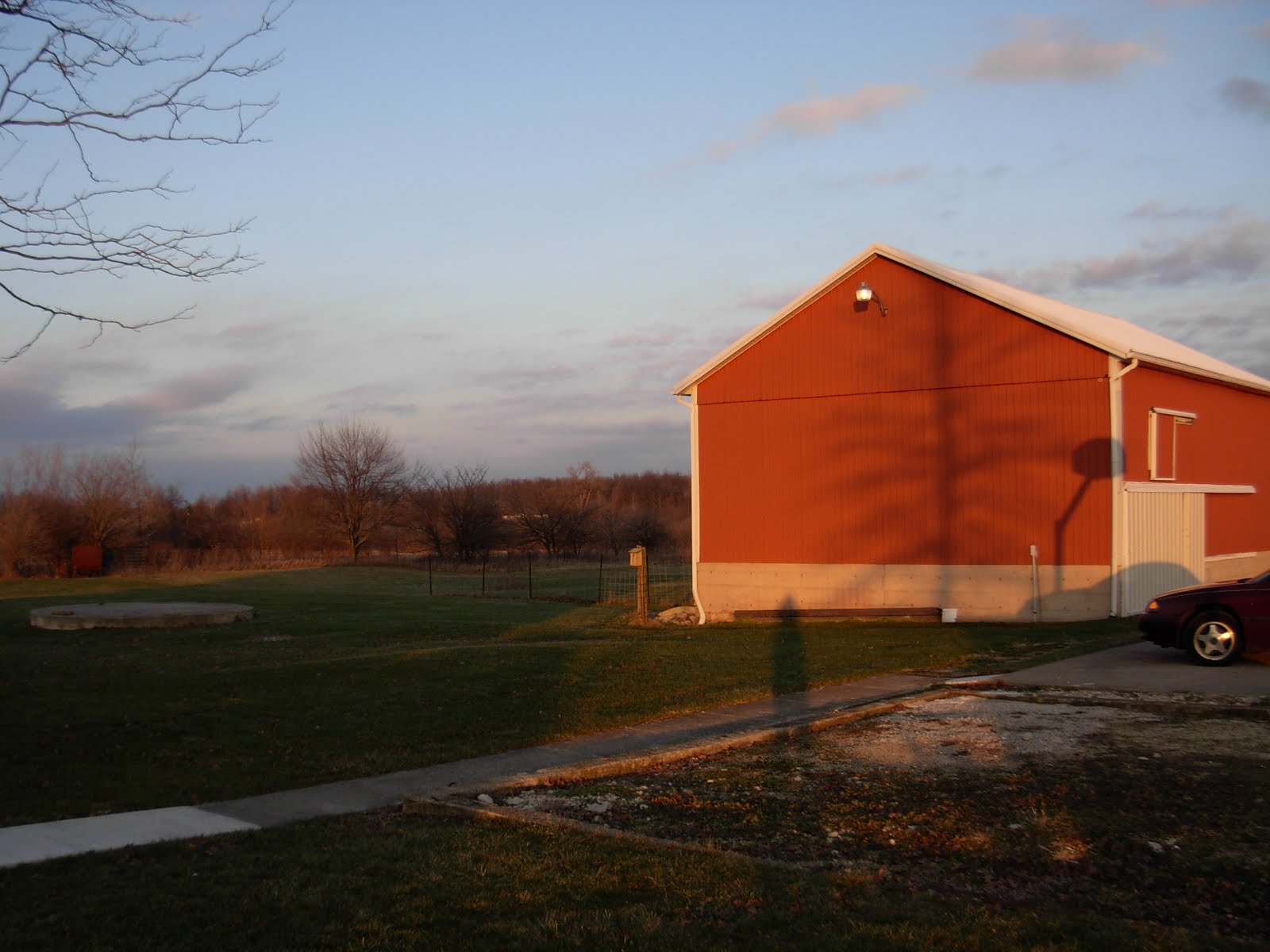
Behind this barn here, we're going to erect a handful of trellis structures to grow 30 18' tall hops vines. We chose Centennial and Nugget as our first two varieties. We've read that both varieties grow well in Indiana and both have a relatively high alpha content (which factors into the quality of the beer). It looks like we should not expect a large yield the first year or so, even if we do everything right. So, we'll likely compost the harvest for next year's crop unless we find a home or nano-brewer interested in a wet hop ale.

Next up, we:
  1. perform a soil test
  2. Till and prepare the land
  3. Apply any 'amendments' to adjust PH levels in the soil
  4. Install the hardscape (the trellis structures)
  5. and finally plant the silly things
and all this happens in the next 6-7 weeks (yikes). I plan to post on as much as I can.

This is pretty fun to plan and watch grow from a random suggestion into a reality. I'm leveraging a number of different blogs, other commercial hops farmers' sites, a couple of books, the Purdue extension office (barely), and friends with experience in the game. That being said, there are more questions that need answers and a lot of work ahead. We'll keep you posted.